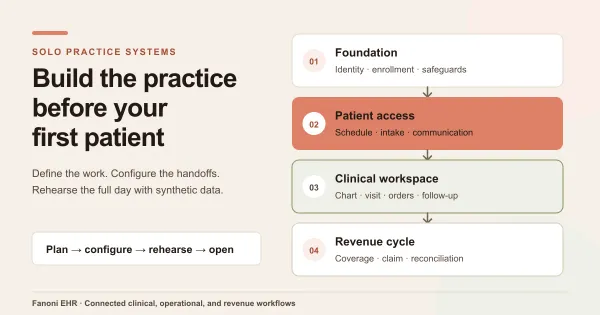
APCM vs. CCM in 2026: what primary care practices need to know
Compare APCM and CCM in 2026, then see how Fanoni connects enrollment, consent, care plans, monthly qualification, exceptions, and draft claims.

APCM vs CCM is not simply a choice between two billing codes. It is a choice between two ways of organizing ongoing care—and two different monthly evidence workflows.
Advanced Primary Care Management (APCM) is a monthly Medicare service bundle that is not tied to a minute-by-minute threshold. Chronic Care Management (CCM) remains time-based for commonly used codes such as 99490. Both require more than a claim line: the practice needs documented consent, an appropriate care plan, coordinated services, reliable patient and coverage data, and a monthly process that makes missing requirements visible before billing.
For primary care practices, the practical question is therefore not “Which code pays more?” It is “Which service can we appropriately deliver for this patient, and can our workflow prove that the requirements were met?”
In brief: APCM is a non-time-based monthly bundle organized around patient complexity and advanced primary-care capabilities. CCM is a monthly care-management service in which applicable codes depend on documented qualifying time and other requirements. Neither program is a shortcut: the service model, patient fit, documentation, and current billing rules all matter.
Explore Fanoni Revenue Cycle · Start your two-week Fanoni EHR trial →
What is APCM?
CMS introduced APCM beginning in 2025 to combine elements of chronic care management, transitional care management, principal care management, and communication technology-based services into one monthly bundle. Unlike time-based care-management codes, the APCM base service does not require staff to reach a monthly minute threshold.
That does not mean APCM is “CCM without the timer.” The CMS APCM requirements describe a broader operating model. Depending on what is clinically appropriate for the patient, the practice must be capable of providing continuity and 24/7 access, comprehensive care management, an electronic patient-centered care plan, transition management, care coordination, enhanced communication, population-level management, and performance measurement.
CMS identifies three APCM base codes:
- G0556: Level 1, for a patient with zero or one chronic condition.
- G0557: Level 2, for a patient with two or more qualifying chronic conditions.
- G0558: Level 3, for a Qualified Medicare Beneficiary with two or more qualifying chronic conditions.
APCM is billed once per patient per calendar month when the applicable requirements are met. Written or verbal consent must be obtained and documented before services begin. CMS also requires an initiating visit in specified circumstances, with exceptions based on the patient's recent relationship with the practice or receipt of another care-management service.
The patient-facing Medicare APCM explanation is useful during enrollment conversations because it explains the monthly service, consent, care coordination, access, and potential patient cost-sharing in plain language.
What is CCM?
CCM supports patients with multiple chronic conditions through an ongoing, coordinated care-management workflow. The CMS Chronic Care Management booklet describes patient eligibility, consent, care planning, access, coordination, and the time requirements attached to the different CCM codes.
For the commonly used clinical-staff pathway, the CMS CCM code table lists 99490 at 20 qualifying minutes in a calendar month and 99439 as an add-on for each additional 20 minutes when its requirements are met. CMS also recognizes other CCM pathways, including complex CCM and time personally furnished by a physician or other qualified health care professional.
This distinction matters. A practice should not treat every CCM patient as a 99490 workflow or count every administrative minute automatically. The team needs a consistent method for recording who performed the work, when it occurred, what care-management activity was provided, and which time can be counted under current guidance.
APCM vs CCM: the operational differences
| Question | APCM | CCM |
|---|---|---|
| How is the monthly service organized? | A bundle based on patient complexity and advanced primary-care service capabilities | A care-management service with time-based requirements for applicable codes |
| Is a monthly minute threshold required? | No threshold for the APCM base service | Yes for commonly used CCM codes such as 99490 |
| What drives code selection? | Patient medical and social complexity, including chronic-condition count and QMB status | The CCM service pathway, qualifying time, who provides the service, and whether complexity requirements apply |
| Is consent required? | Yes, written or verbal consent documented in the medical record | Yes, according to CMS requirements |
| Is a care plan part of the workflow? | Yes; APCM includes an electronic patient-centered comprehensive care plan | Yes; CCM includes a comprehensive care plan and ongoing coordination |
| What should the monthly review catch? | Missing consent, coverage or demographic issues, uncoded conditions, service-element gaps, duplicates, and code/configuration issues | The same core readiness issues plus insufficient or unsupported time and the correct CCM pathway |
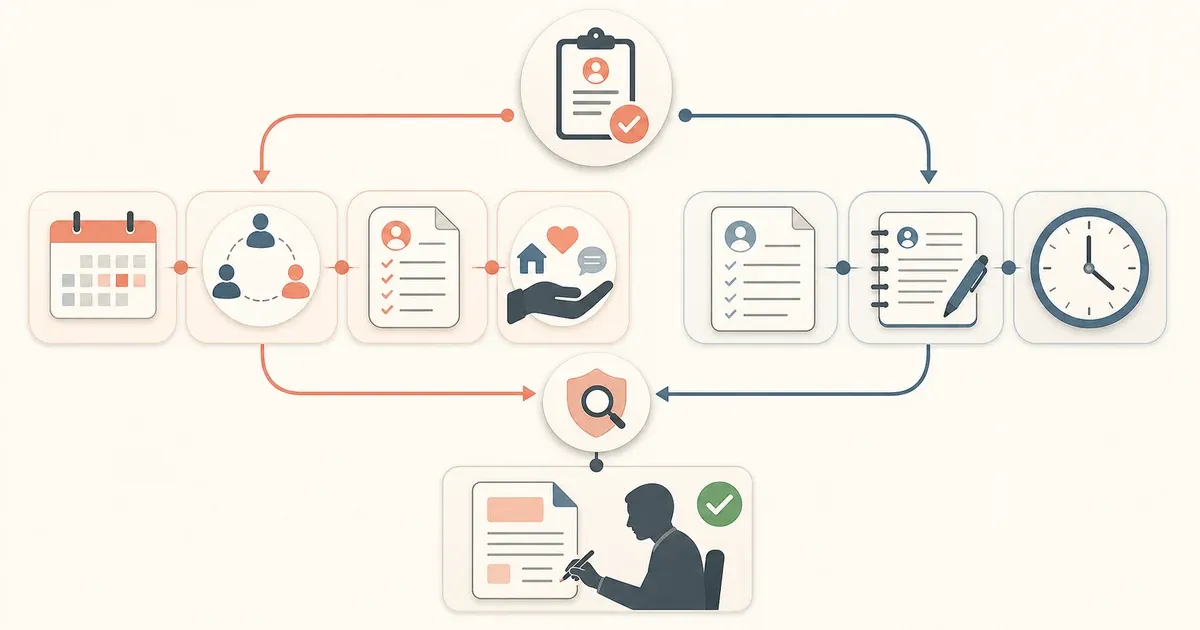
APCM removes the monthly timer from the base service, but both paths still need a reviewable connection between enrollment, the care plan, service evidence, exceptions, and the draft claim.
The Medicare Payment Advisory Commission's March 2026 report lists APCM alongside CCM and other primary-care services. The comparison reinforces the central operational difference: APCM uses a monthly complexity-based model, while common CCM services retain documented time thresholds.
What changed for APCM in 2026?
For calendar year 2026, CMS added three optional codes that allow behavioral health integration or the psychiatric Collaborative Care Model to be reported with an APCM base code when all requirements are met.
The CMS behavioral health integration guidance identifies:
- G0568 and G0569 for psychiatric Collaborative Care Model services delivered to patients also receiving APCM; and
- G0570 for general behavioral health integration delivered to patients also receiving APCM.
These codes are not a generic “behavioral health” checkbox. A practice must meet the requirements for the applicable service and report the APCM base code in the same month. Teams should review the current CMS guidance, payer rules, and their own delivery model before adding them to a billing workflow.
The difficult part is the monthly evidence trail
Removing a time threshold does not remove operational work. In fact, APCM asks a practice to demonstrate a broad set of ongoing primary-care capabilities. CCM asks the practice to preserve a reliable record of qualifying work and time. In both cases, weak handoffs between the chart, care-management team, and billing queue can create preventable friction.
Common failure points include:
- consent captured on paper but not connected to the monthly review;
- chronic conditions present in free text but not represented with usable codes;
- a care plan that is missing, inactive, or disconnected from the conditions being managed;
- CCM activity stored across notes, messages, and spreadsheets with no reliable monthly total;
- coverage information that lacks a member identifier or is no longer active;
- a billing practitioner without the required identifier in the workflow;
- a fee schedule that is missing, expired, or not reviewed for the billing period;
- a second claim prepared for a patient-month that was already billed; and
- a worklist that says “not ready” without explaining what staff need to fix.
This is where practices lose time: not on one complicated decision, but through dozens of small exceptions discovered late in the month.
A safer monthly APCM and CCM workflow
1. Enroll the patient and document consent
Enrollment should connect the selected program, the patient's consent, and a dedicated care-management plan in the record. Staff should be able to see whether consent was verbal or written, when it was recorded, and whether an active program already exists.
Patients also need a clear explanation of the service, their right to stop, and potential cost-sharing. Consent is not merely a field needed for a clean claim; it is part of an informed care relationship.
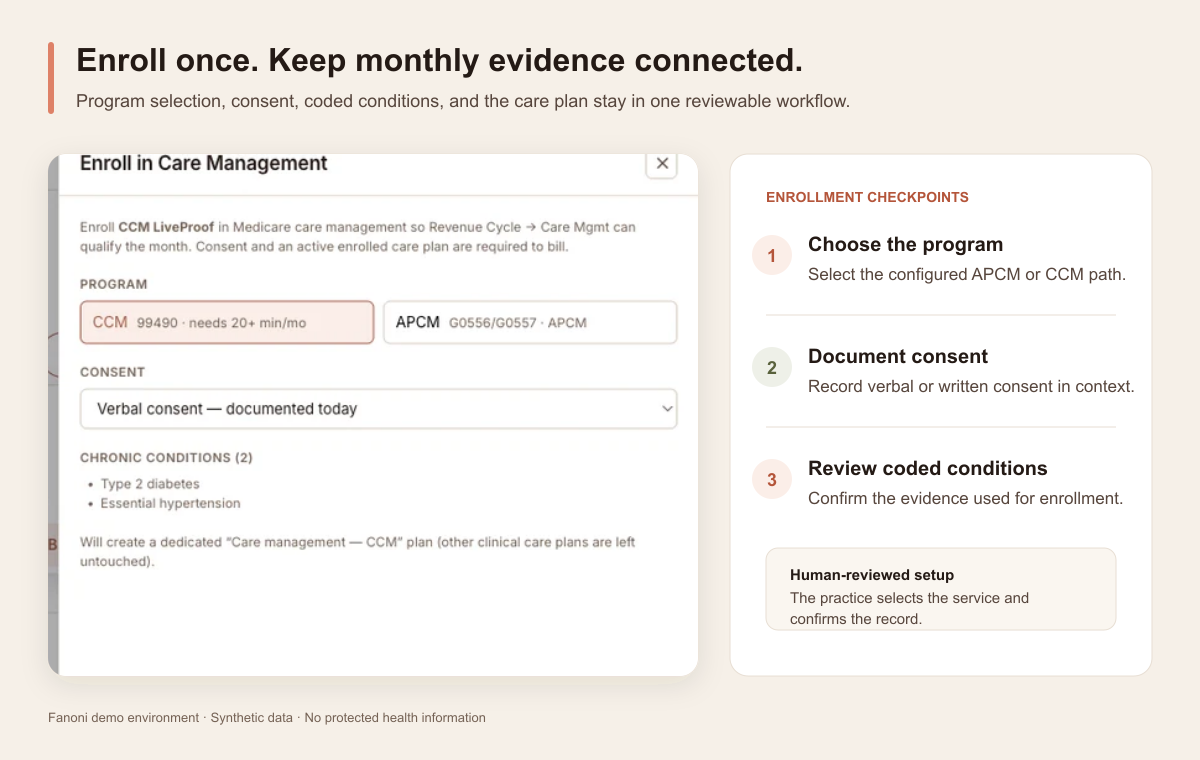
Fanoni demo environment with synthetic data: enrollment connects the program choice, consent, chronic conditions, and a dedicated care-management plan.
2. Keep the care plan connected to coded conditions
A care plan becomes more useful when the conditions it addresses can be resolved to the clinical record. Coded diagnoses support consistent patient identification, monthly review, and claim preparation. They also make a missing-data problem visible before it becomes a billing problem.
3. Record service evidence as work happens
For CCM, qualifying time should be recorded with the activity rather than reconstructed at month-end. Staff should be able to see the running monthly total without assuming that time alone makes the patient billable.
For APCM, a timer is not the organizing principle, but the practice still needs evidence that its service capabilities are real and available. Care-plan updates, communication, transitions, referrals, outreach, medication work, and other clinically appropriate activity should remain part of the patient's longitudinal record.
4. Qualify the patient-month before creating a claim
A useful monthly review is a set of explicit checks, not a black-box “eligible” badge. It should examine the data needed for the practice's configured workflow and return a specific reason when something is missing.
Examples include “missing consent,” “no active Medicare coverage,” “member ID missing,” “no coded chronic diagnosis,” “insufficient CCM minutes,” “billing practitioner has no NPI,” “fee schedule unavailable,” or “claim already exists for this month.”
The purpose is not to replace a biller's judgment. It is to give the biller a smaller, clearer exception queue.
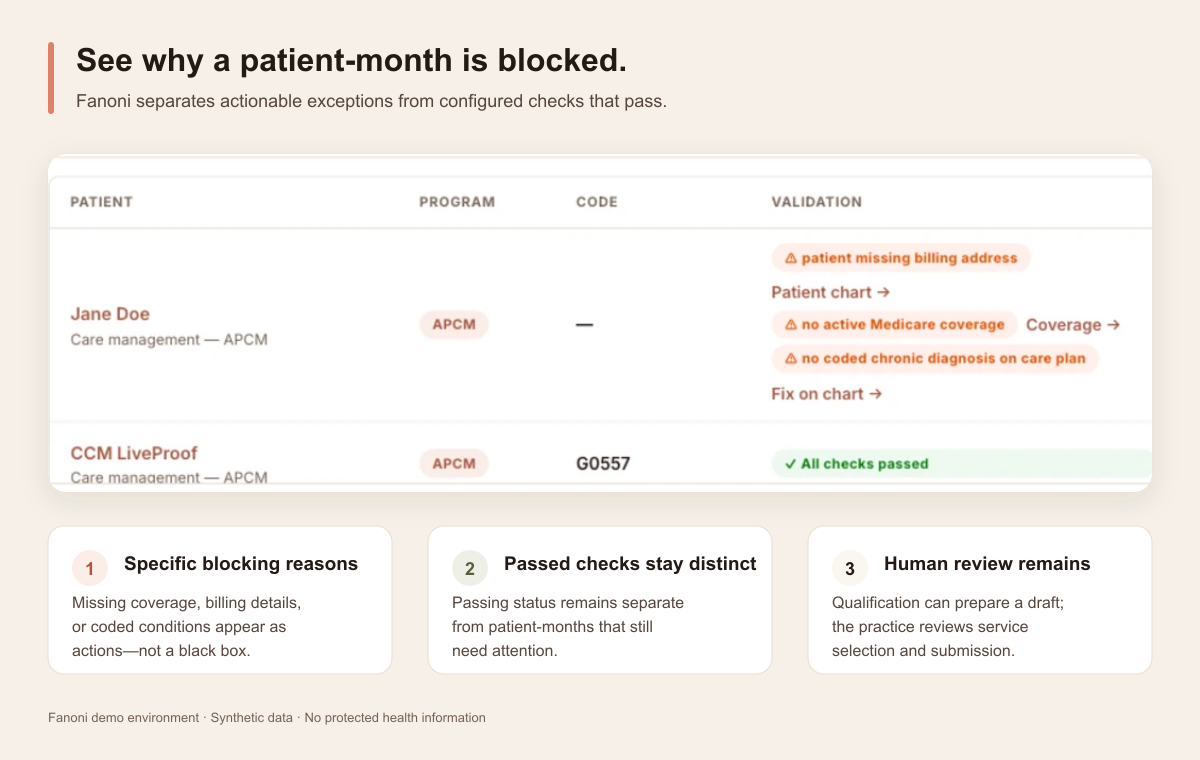
Fanoni demo environment with synthetic data: the monthly view separates actionable exceptions from a patient-month whose configured checks have passed.
5. Generate a draft claim for review
Once the supported checks pass, the system can prepare a draft claim using the applicable code, diagnoses, place of service, and a reviewed fee schedule. A draft keeps a human checkpoint between monthly qualification and payer submission.
That boundary matters because CMS rules, payer contracts, practice participation, patient circumstances, and code configurations can change. Automation should make the evidence inspectable and the exception actionable—not turn uncertainty into a submitted claim.
How Fanoni supports APCM and CCM operations
Fanoni connects care-management enrollment, the patient chart, care plans, monthly qualification, and Revenue Cycle in one EHR workflow.
The current verified workflow described here can:
- enroll a patient in APCM or CCM from the chart;
- record verbal or written care-management consent;
- create a dedicated care-management plan without replacing other clinical care plans;
- show the patient's coded chronic conditions and active coverage context;
- record non-face-to-face CCM time and display the current monthly total;
- run a monthly qualification pass across enrolled patients;
- show a patient-level reason for each blocked month;
- check for consent, active Medicare coverage, member ID, billing address, practitioner NPI, coded diagnoses, duplicate monthly claims, and an active fee schedule;
- resolve supported fee amounts from date-valid configuration rather than burying them in automation code; and
- create draft claim lines for supported, qualified patient-months for billing review.
Fanoni currently verifies this workflow for G0556, G0557, 99490, and 99439. Practices using G0558, complex CCM, practitioner-time CCM, the 2026 behavioral-health add-ons, or payer-specific variations should confirm the required configuration and current product scope with Fanoni before implementation.
Want to see how the connected workflow feels in practice? Start a two-week Fanoni EHR trial to explore the EHR, care-management, and revenue-cycle experience for your organization.
This is intentional product design: a missing fee schedule or required record blocks the draft instead of inventing a value. A duplicate month becomes an exception instead of another claim. And a patient who is not ready appears with a reason the team can investigate.
See Fanoni Care Plans · Review Fanoni pricing
How to evaluate the monthly workflow
Fanoni does not make a universal revenue or reimbursement prediction. Results depend on the patient population, staffing model, payer mix, services delivered, documentation quality, and current workflow.
What the practice can measure is more concrete:
- how many enrolled patients are reviewed before month-end;
- how many patient-months are blocked and why;
- how much staff time is spent reconstructing CCM activity;
- how often consent, coverage, diagnosis, or fee-schedule gaps are discovered late;
- how many duplicate drafts are prevented;
- how many qualified months reach human billing review; and
- how long exceptions remain unresolved.
Those measures create an operational baseline the practice can evaluate without treating a marketing estimate as a measured result.
Questions to answer before choosing APCM or CCM
Before changing a care-management program, a practice should ask:
- Does this patient meet the current Medicare and payer requirements for the service?
- Can the practice consistently provide every required service capability—not only document a code?
- Where will consent, the care plan, service activity, communication, and CCM time be recorded?
- Who owns the monthly exception queue?
- Which codes and fee schedules are configured and reviewed for the practice?
- Who reviews the draft claim before submission?
- How will the practice measure patient participation, staff workload, documentation quality, and billing outcomes?
The best answer may differ by patient. A reliable system should support that judgment while applying the same evidence and review discipline every month.
Frequently asked questions
Is APCM time based?
No. The APCM base service is billed monthly and does not have a minute-by-minute threshold. The practice must still meet the applicable service requirements and maintain appropriate documentation.
What is the main difference between APCM and CCM?
APCM is a broader monthly bundle organized around patient complexity and advanced primary-care capabilities. Common CCM codes are organized around chronic-care services with qualifying monthly time. Both require consent, care planning, coordination, documentation, and an appropriate billing workflow.
What are G0556, G0557, and G0558?
They are the three APCM base codes. CMS differentiates them using the patient's chronic-condition count and, for G0558, Qualified Medicare Beneficiary status. Practices should use current CMS guidance to determine the appropriate service and code.
Can APCM and CCM be billed for the same patient in the same month?
APCM incorporates elements of CCM into a monthly bundle, so practices should not assume the two base services can simply be stacked. Review current CMS code-pair guidance, payer rules, and any model-specific requirements for the patient and billing practitioner before submitting a claim.
Does Fanoni decide eligibility or payer reimbursement?
No. Fanoni can organize configured checks, evidence, exceptions, and draft-claim preparation. Final service selection, coding, billing review, and submission remain the responsibility of the practice and its qualified professionals. Payer reimbursement remains outside Fanoni's control.
Build the workflow around the care—not the month-end scramble
APCM and CCM can both support more coordinated longitudinal care, but only when the service model and the operational system agree. Enrollment, consent, care plans, work records, qualification checks, exceptions, and claims should be parts of one reviewable process.
Fanoni is built to make that process visible: what the practice is delivering, what evidence is present, what is missing, and what a human reviewer needs to do next.
Start your two-week Fanoni EHR trial → · Book a personalized Fanoni discovery call
This article is for educational purposes and is not legal, coding, billing, or reimbursement advice. Medicare and payer requirements change. Verify current CMS guidance, payer policies, code-pair rules, fee schedules, and professional requirements before billing.